
Cart 0


Hello again, Trainers! If you’ve been following livestreams of recent Pokémon Trading Card Game Regional Championships, you’ve likely noticed the recent dominance of Dragapult ex. Many of its poor matchups either featured cards that rotated out with the “G” block or fell into a worse position due to other emerging decks, meaning this devious dragon is mostly unchecked in today’s Standard format. However, Mega Evolution—Chaos Rising introduces some new contenders that should shake up the meta, boosting the viability of some current archetypes. Only time will tell if these stars can dethrone the current champion of the Standard format. Without further ado, here are my top five picks.
Mega Greninja ex

Mega Greninja ex is my favorite card in the upcoming set. While Active, its Mortal Shuriken Ability lets you discard a Basic Water Energy to place six damage counters on one of your opponent’s Pokémon. Its attack isn’t too shabby either: for two  Energy, Ninja Spinner does 120 damage, plus 80 more if you return one of its attached Energy to your hand. Combined with the additional damage from Mortal Shuriken, Mega Greninja ex can pick up Knock Outs while avoiding counterplay from Unfair Stamp.
I have yet to mention Greninja ex from the Scarlet & Violet—Twilight Masquerade expansion. This card has been its own fringe archetype for a while but hasn’t really found its niche. Mega Greninja ex is exactly the edge the deck needs to compete with the rest of the Standard format. The additional six damage counters are enough for Shinobi Blade to Knock Out Basic Pokémon ex like Teal Mask Ogerpon ex and Latias ex, or enough for Mirage Barrage to Knock Out Meowth ex on the Bench.
If you’re able to use Mortal Shuriken more than once, either across multiple turns or with multiple Mega Greninja ex, the damage will start to add up on the opponent’s board. Finally, Greninja ex is weak to Psychic while Mega Greninja ex is weak to Lightning, meaning you can select which attacker is more effective for the opposing matchup.
The most common variants of Mega Greninja ex I’ve seen online make use of Drakloak and Dragapult ex or Dudunsparce as their partner of choice. These sidekicks provide additional consistency through their card-drawing Abilities, as well as a secondary attacker that complements the deck’s nature; Dudunsparce ex can handle aggressive Basic Pokémon ex decks, whereas Dragapult ex can spread damage to best capitalize off Mortal Shuriken. Both lists traditionally choose Neo Upper Energy or Grand Tree as their ACE SPEC. I’m confident we will see Mega Greninja ex win a tournament in the Standard format, and time will tell if this deck can stand up to the likes of Dragapult ex.
Special Red Card
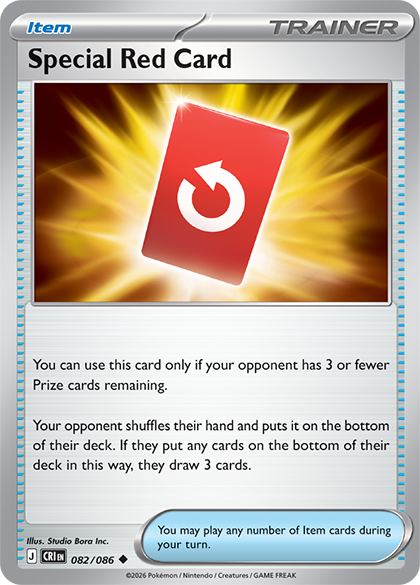
Hand disruption is hard to come by in the current Standard format. Unfair Stamp is the ACE SPEC of choice for that reason, with some decks also opting to play one or two copies of disrupting Supporter cards like Judge or Lucian. Thankfully, Special Red Card is joining the format as a new Item that disrupts an opponent’s hand without taking up the ACE SPEC slot. You can only play it if the opponent has three or fewer Prize cards remaining, but if you do, the opponent shuffles their hand to the bottom of the deck and draws three cards. I expect most decks to play one copy of this card.
Though the meta may remain largely unchanged with this release, I expect it will diversify the ACE SPEC choice in slower decks. Hero’s Cape and Neo Upper Energy have seen sparing play in Dragapult ex variants so far, and I imagine those numbers will only increase after the release of Special Red Card. Arguably, decks may still elect to play Unfair Stamp so they can meaningfully disrupt the opponent twice. You could use Unfair Stamp after the opponent takes their first set of Prize cards, then Special Red Card once they drop below three Prize cards. It’ll be an interesting decision for deck builders moving forward.
Patrat
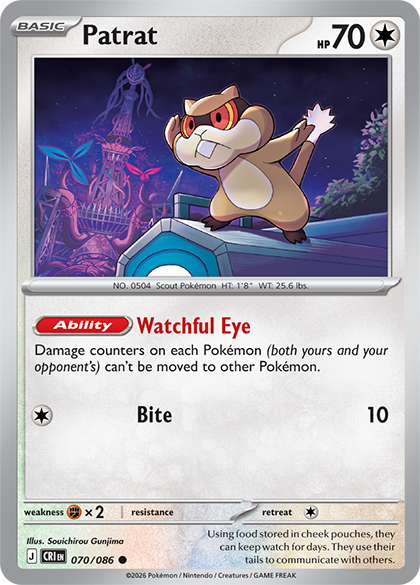
Munkidori has been the defining card of the Standard format for the last two years. You’ll see that even in today’s format, most decks are playing 1–2 copies even if their primary attacker doesn’t use  Energy. Munkidori is simply too powerful as both an offensive and defensive instrument, especially against Dragapult ex. But enough about Munkidori—Patrat:series is here to keep a Watchful Eye on both you and your opponent! While the Scout Pokémon is in play, neither player can move damage counters from one Pokémon to another. Patrat completely stops Munkidori in its tracks.
The one downside to Patrat is its Colorless type. Munkidori decks can adapt, choosing to include one or two copies of Team Rocket’s Watchtower to shut off Patrat’s Ability, therefore allowing the use of Munkidori’s Adrena-Brain. We may enter a meta where we see rebounding levels of Munkidori and Patrat. As has been the case with Dusknoir and Psyduck, or Crustle and its counters, these predatory counter cards become stronger as their prey becomes more popular. Munkidori and Patrat may be the one exception to this rule, though—Munkidori is simply too popular to warrant removing it, so expect to see each deck take advantage of Munkidori or attempt to shut it off with Patrat for the near future.
Beedrill ex
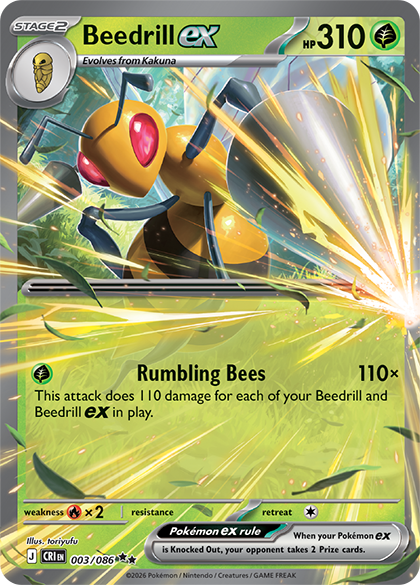
Beedrill ex is yet another hard-hitting Stage 2 Pokémon that Grass-type decks have at their disposal. Unlike current Grass-type archetypes that make use of a mix of Arboliva ex, Meganium, and Mega Venusaur ex, Beedrill ex thrives on its own, increasing the damage of its Rumbling Bees attack based on the number of Beedrill and Beedrill ex you have in play. Your damage output is correlated with the number of Beedrill ex you can put into play, so naturally the deck’s optimal strategy is to put three Beedrill ex in play as soon as possible and begin swinging for brutal damage. No need for secondary attackers or Teal Mask Ogerpon ex when Beedrill ex can hit for up to 440 damage for a single Energy.
Despite Beedrill ex’s strength on paper, I’m reluctant to forewarn that it will eclipse the current Grass-type archetypes. Arboliva ex does a great job of slowing down popular Stage 2 decks, punishing them for slow starts. Even though Beedrill ex has a higher damage ceiling, being able to spread 120 damage around is likely more useful than the monstrous damage inflicted upon a single Active Pokémon. It’s also possible that one or two copies of your Beedrill Evolution line end up in the Prize cards, meaning it’ll be tough to set up 3–4 in play.
Metagross
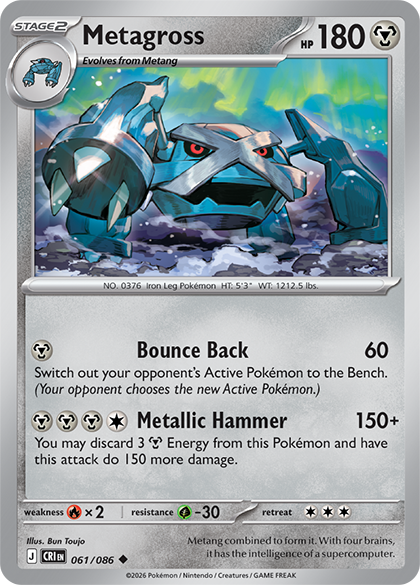
The final card to cover today is Metagross. Its second attack, Metallic Hammer, does 150 damage, and you may discard three Metal Energy and have it do 150 more. However, this additional damage clause doesn’t actually require any Metal Energy attached to the Pokémon in the first place—which is relevant for Slowking from Scarlet & Violet—Stellar Crown. This deck traditionally played Conkeldurr as its heavy hitter, but Metagross caps out at 300 damage rather than 250. This difference is best described as the list of popular Pokémon it can now Knock Out with a single attack: Mega Kangaskhan ex, N’s Zoroark ex, and Team Rocket’s Mewtwo ex. With this release, Slowking now has an additional heavy hitter, giving it perhaps just the right amount of juice needed to deal with some of the opposition that was otherwise out of reach for its inspirational desires.
Mega Evolution—Chaos Rising will bring about unique intricacies in how people build decks in Standard, particularly with Special Red Card and Patrat. Now, decks will be able to play a wider variety of ACE SPEC cards, and those that are unable to use Munkidori effectively have an easy answer that only takes up a single deck slot. On the other hand, Beedrill ex and Mega Greninja ex are powerful enough to spur their own archetype, and Metagross may push Metang-based decks or Slowking over the edge. I’m excited to see what novel concepts Trainers create at the upcoming tournaments!